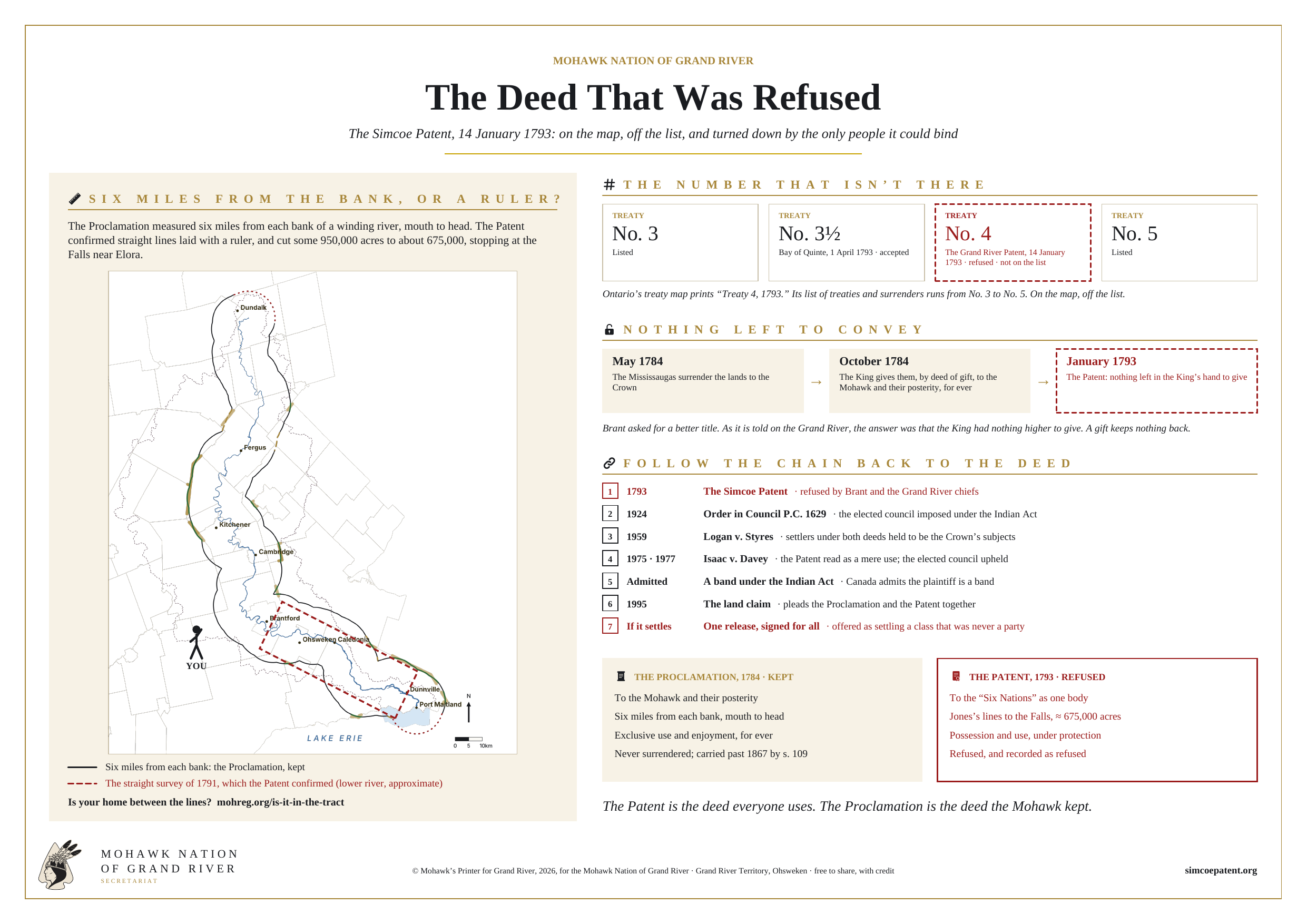
On 14 January 1793 Simcoe put a patent for the Grand River under the great seal. Brant and the Grand River chiefs refused it. Maps call it “Treaty #4.” Courts, councils and claims still stand on it.
≈ 675,000 acres, against the Proclamation’s ≈ 950,000
“Treaty #4” on Ontario’s map, missing from its list
refused by Brant and the Grand River chiefs
The six miles the Patent tried to cut down
Nothing left to convey
In October 1784 the King gave the lands by deed of gift. A gift, once made, is complete: the giver keeps nothing of what he gave, and cannot give it a second time. When Simcoe put a patent for the same lands under the great seal nine years later, the King had no interest in them left to convey. No one can give what they do not have.
May 1784The Mississaugas surrender the lands between the lakes to the Crown
→
October 1784The King gives them, by deed of gift, to the Mohawk and their posterity
→
January 1793The Patent: nothing left in the King’s hand to give
The Mississaugas parted with it
In May 1784 the Mississaugas surrendered the lands between the lakes to the Crown. A surrender passes the whole of what the people surrendering held. It was that, and only that, the King had to give.
The King parted with it
In October he gave it on, in his own name, to the Mohawk and their posterity, “for ever.” A deed of gift keeps nothing back. What the Mississaugas gave up to the Crown, the Crown gave up to the Mohawk.
The Patent had nothing to pass
A patent can pass only what the Crown still holds. On the Grand River, after October 1784, it held no interest to grant, so the Patent could add nothing and take nothing away, even before Brant refused it.
Brant asked for a better title
Brant pressed for the strongest title the Crown could give. In March 1791 he warned Lord Dorchester that a restricted grant would be “not much better than a Yankee deed.” As it is told on the Grand River, the answer came back that there was nothing higher the King could give: the gift already made was the fullest he had to make.
That answer is a surrender in all but name. A grantor who says there is nothing higher to give has given everything he had, as the Mississaugas gave everything they held when they surrendered in May 1784. Nothing was kept back in either step, and nothing was left for 1793.
The Nation’s understanding, as it is told on the Grand River. The Crown’s own words for the answer are being searched for in the Colonial Office papers (CO 42) and Haldimand’s papers; when they are found, they will stand here. Brant’s petition of March 1791 is in the record of refusal below.
The two dogs: the tenure others asked for
In 1787 the chiefs of Kanehsatake delivered the Two Dog belt, made about 1721: a dog at each end, facing out to guard the boundary, eight men hand in hand between them, and the land beneath. In the speech that went with it, as their reading of 1787 records, they asked the Crown for the same tenure as the Mohawks at the Grand River.
Three years after the gift, and six years before the Patent, other Mohawks held up the Grand River title as the one worth asking for. No one asks for a tenure that is only possession at the King’s pleasure. They asked for what the King had already given away on the Grand River, whole.
The Two Dog belt, Kanehsatake, made c. 1721, delivered 1787; McCord Museum, M1904. Drawn for Flint and Feather from the chiefs’ own reading of 1787, a photograph, and the Secretary-General’s reading of the belt. What “the body” means in the chiefs’ words is still open.
Said plainly, because the Crown will say it: Simcoe’s own minute held that under Haldimand’s instrument the property, as well as the sovereignty, still remained in the King. That is the Patent’s reading written back into the Proclamation: if the property stayed with the King, the Patent had something to give and Brant had nothing to refuse. But the Crown offered the Patent, Brant refused it, and the Crown recorded the refusal. A grant the King believed he still held the land to make was turned down by the only people it could bind.
The number that isn’t there
Ontario’s own list of treaties and surrenders runs straight past it. Its treaty map does not.
TreatyNo. 3
Listed.
TreatyNo. 3½
The Bay of Quinte deed, 1 April 1793. Accepted.
TreatyNo. 4
Not on the list. The Grand River Patent, 14 January 1793. Refused.
TreatyNo. 5
Listed.
Ontario’s treaty map prints “Treaty 4, 1793”; its list of treaties and surrenders runs from No. 3 to No. 5. On the map, off the list: the Province’s own records disagree about the one deed the Grand River refused.
Ontario, Map of Ontario treaties and reserves (files.ontario.ca/treaties_map_english.pdf), and Ontario’s list of treaties and surrenders.
Searching for “Treaty 4”?
Treaty 4, 1874The Qu’Appelle Treaty, made at Fort Qu’Appelle in what is now Saskatchewan. A numbered treaty, signed by the Cree and Saulteaux. Not this page.
“Treaty #4”, 1793The label Ontario puts on the Simcoe Patent for the Grand River. Never signed by the Grand River Mohawk, and missing from Ontario’s own list. This page.
Six miles from the bank, or a ruler?
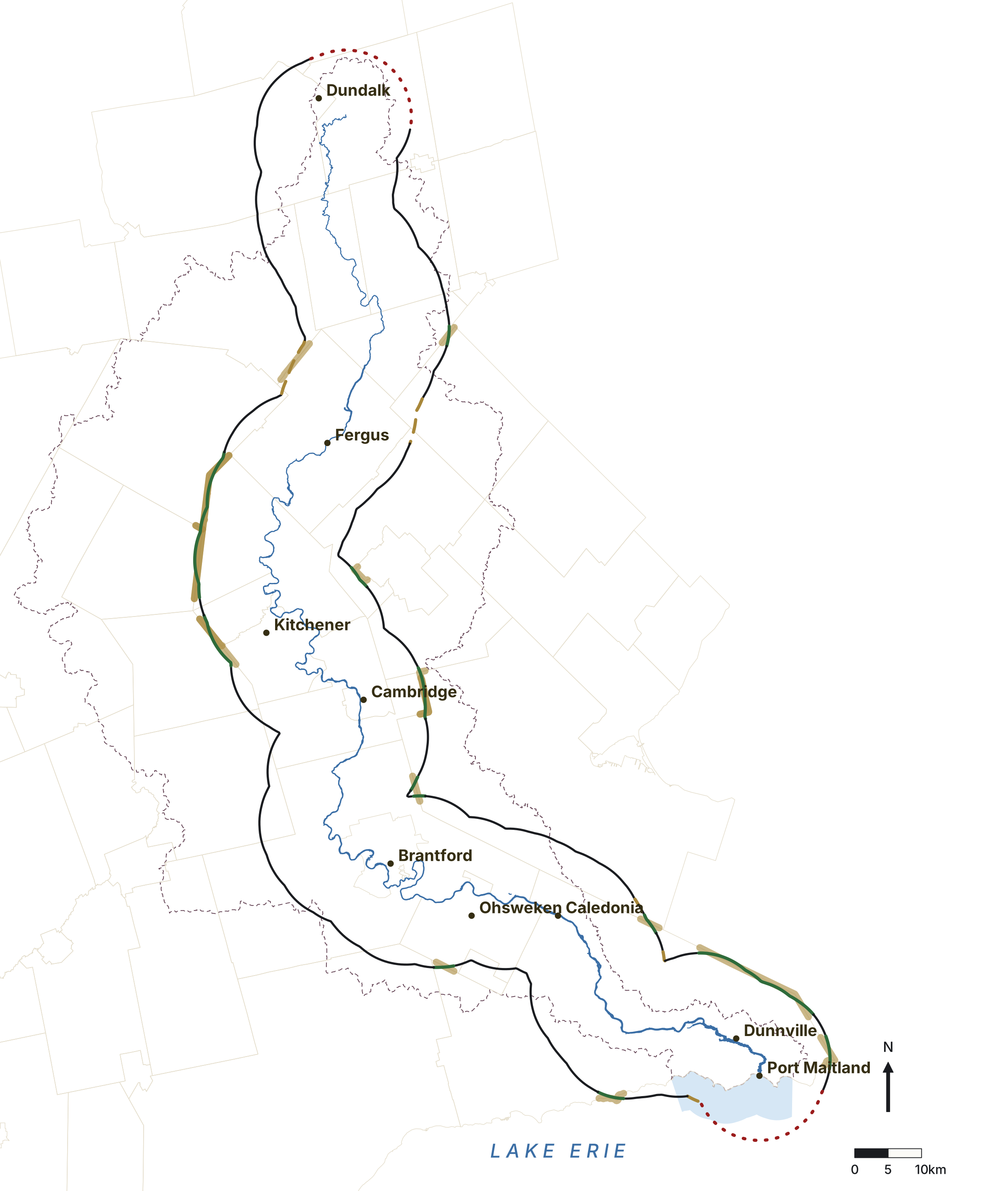
The red dashes are the straight survey of 1791, the lines the Patent confirmed. The black line is the true six miles the Proclamation measured from each bank, following every bend. Tap any place for whether it lies inside, how far it is from the line, and whose ridings it is in.
The six miles, measured from the banks Within the six miles The Grand River
If the Patent’s road worries you, say so to the people who decide. Your own letter, in your own name, to your member of Parliament and your member at Queen’s Park, found from the ridings themselves. Tap the map, or use your location.
Follow the chain back to the deed
Every link below stands on the one above it. At the top is the deed Brant refused.
14 Jan 1793
The Simcoe Patent
Names the “Six Nations,” cuts the lands, gives possession and use. Refused by Brant and the chiefs.
1924
Order in Council P.C. 1629
The elected council imposed by the Crown under the Indian Act.
1959
Logan v. Styres
Those who settled under the Haldimand and Simcoe deeds came under the Crown’s protection and became its subjects.
1975 · 1977
Isaac v. Davey
The Court of Appeal reads the Patent as a personal and usufructuary right and upholds the elected council. The Supreme Court dismisses the appeal on another ground.
“…confirmed that they are the lawful government in the case of Isaac and Davies by the Supreme Court of Canada…” · Lands and Resources director, 19 August 2026
Admitted
A band under the Indian Act
Canada admits the plaintiff is a band with standing to sue.
7 Mar 1995
The land claim
Pleads the tract of “the 1784 Haldimand Proclamation and 1793 Simcoe Patent.”
If it settles
One release, signed for all
A judgment or settlement for the band, on the Patent’s road, would be offered as settling the interest of everyone, including a class that was never a party.
How a hereditary class is made to disappear
The Proclamation was made to a named class: the Mohawk and their posterity, the Loyalists of the three villages and their line, by blood or by adoption. The Patent’s road does not defeat that class. It dissolves it, in three steps.
Loyalist Mohawkand their posterity
→
“Six Nations”one body
→
Band listIndian Act
→
Descendantsnot on the list
Step one · novation
A new grantee for the old one
The Patent tried to put the “Six Nations” in the place of the Mohawk as the party to the grant. In law that is a novation: one party swapped for another. A novation needs the consent of the party being replaced.
It never happened. Brant refused.
Step two · substitution
The larger group stands in
Courts and councils then treat the larger group as if it had always been the holder, as an entail passes to substitute heirs when the named line fails.
But the named line has not failed. The posterity is alive, worldwide.
Step three · absorption
The list replaces the line
The group becomes a band, and the band’s list becomes the class. Descendants who are not on it, through marriage rules, adoption or distance, fall out of a grant that never excluded them.
The class is not defeated. It is erased.
The posterity changes with every generation
The class the Proclamation names is not a fixed list. It grows and spreads with each generation: through daughters and sons, through marriage out and back, through adoption, across borders. The structures that claim to speak for it each follow only one thread of that line, and each loses more of it as the generations go on.
The council
Follows the band list
Membership set by the Indian Act. For generations it stripped status from women who married out and from their children, until 1985. Whole branches of the line were written off the list.
The clan
Follows the mother
Clan passes through the female line. A descendant through a son, or whose mother married out, can carry the blood of the three villages and no clan at all.
The posterity
Follows the line, every branch
The Proclamation runs to the Mohawk “and their posterity,” and the Mark of Honour marks descent through either sex, with adoption by the Nation’s law. It is the only measure that keeps every branch.
Read the bars from the top. Each bar is the whole posterity in one generation, growing as the line grows. Green is the part a band list and a clan both reach; pink, the part only one of them reaches; red, the part neither reaches.
1784
c. 1840
c. 1900
c. 1960
Today
On a band list and in a clanCaught by one of them onlyThe posterity caught by neither
An illustration of the pattern, not a count. The bar grows as the posterity grows; the red part is the share of the line that no council and no clan accounts for.
Neither the council nor the clan structure accounts for the posterity in total, and neither can, because each was built to follow one thread. Every generation the gap widens. A release signed by either would bind a class it cannot even count.
The City’s answer. When the Haldimand Proclamation was raised with the City of Brantford over the Arrowdale lands, the City Solicitor answered, in substance, not to forget the Simcoe Patent. The meaning was plain: the Mohawk took the Patent, became subjects, and the Six Nations speak for them now.
That is the whole danger in one line. Every time the Patent is offered as the answer to the Proclamation, the Loyalist Mohawk class is quietly swapped for a larger group that can be counted, represented and settled.
Why the Patent matters to the Crown: it is the cure
A latent defect is a flaw in title that does not show on the register but runs with the land, sale after sale. The Haldimand interest is one. The Patent’s road is the only way to clear it, and that is why it keeps being offered.
Parcel register · a lot within the true six miles · illustration
1784
Crown purchase from the Mississaugas
1784
Haldimand Proclamation: exclusive use and enjoyment to the Mohawk and their posterity. Not shown.
18—
Crown patent to purchaser
19—
Transfer
19—
Charge / mortgage
20—
Transfer to present owner
—
No notice of any Mohawk interest
What the register leaves out. Ontario took the Crown’s lands in 1867 under section 109 “subject to any Interest other than that of the Province in the same.” The Haldimand interest was such an interest. It was never surrendered and never entered on title.
So every title in the Tract carries it unseen. The Province and the Crown never put it on the register, and buyers, banks and owners were never told.
A defect like that has only one cure: a release by the people who hold the interest.
The register illustrates the pattern; it is not a real parcel.
On the Patent’s road
The interest as the Crown would like it read
Possession and use, under protection: an interest in occupation, not in the land itself.
Held by the “Six Nations” as one body, which becomes a band.
A band can surrender, settle or be paid out by judgment.
One release, signed for all, and the defect is cleared from every title at once.
The Mohawk need never be asked. Folded into the group, they lose their say, and no one is pushed to recognise them.
On the Proclamation’s road
The interest as it was made
Exclusive use and enjoyment, “for ever”: an interest in the land, held whether or not anyone stands on the ground.
Made to the Mohawk and their posterity: a hereditary class, by blood or adoption.
Only that class could release it, and a posterity that includes the unborn cannot sign it away.
No release exists. The Patent was refused.
The defect stays on every title. The Mohawk keep their say, and the Crown and Ontario carry the failure to record it.
Acquired territory
A Crown-derived interest by deed of gift, not an Aboriginal right under section 35. It does not depend on occupation or a collective claim.
Section 109
Ontario received its lands already subject to this interest. Refusing the Patent kept it whole.
Section 52
The Constitution is the supreme law. Any statute, registration or vote inconsistent with the interest is of no force or effect to the extent of the inconsistency.
Why the Crown keeps the band at the table
The arrangement suits both sides of it. The band asks to be recognised as the government of everyone the Proclamation covers. The Crown needs exactly that: one body it can treat as able to surrender, settle and sign. Each gives the other what it wants, and the Mohawk class pays for it.
The band asksTo be recognised as the one government for all Six Nations, Mohawk included.
The Crown recognisesCanada and Ontario deal with the elected council as the only valid voice.
The council actsIts councils, claims and settlements are treated as speaking for the whole Tract.
The defect is “cured”What the council gives up is offered as a release of the Haldimand interest itself.
Recognition in, release out.
The surrenders the Crown relies on, in its own expert’s words
When the City of Brantford sought its 2009–10 injunction, the expert report it relied on, by Joan Holmes, looked at the council of December 1844 said to have surrendered much of the Tract. It found:
“I am not aware of any Order in Council or deed of conveyance that was executed at this time…”
“Whether or not a valid surrender was made is a matter for the court to decide.”
“…has not been systematically reviewed by either Professor Johnston or myself.”
The 1841 surrender “had been withdrawn.”
Wrong party
The council was never the holder
The grant was made for the Mohawk. Stone recorded it as “notoriously made for the exclusive benefit of the Mohawk nation,” and in 1803 the league was found never to have been clothed with any right to speak for them. A body that never held the interest cannot give it up.
Wrong class
The posterity sits outside the structure
The interest runs to a hereditary line, by blood or adoption, worldwide. Most of it is not on any band list. A council chosen under the Indian Act cannot speak for people its own rules leave out.
No consent possible
The faces yet to come
A posterity includes the unborn. They cannot consent, and no one alive can consent for them. No one can give what they do not have.
Said plainly, because the Crown will say it: Mohawk chiefs sat in the 1844 council, and Chief Henry Brant gave the reply. The question was never who sat in the room. It is whether any council, Mohawk chiefs included, could release an interest held by a hereditary class and its unborn, with no deed and no Order in Council to show for it.
Joan Holmes, report of 19 January 2009 and supplemental report of 2 February 2009, prepared for the City of Brantford; William L. Stone, Life of Joseph Brant (1838), vol. II.
Same governor, same year, two outcomes
Grand River Patent
14 January 1793 · “Treaty #4” on the map
To
The “Six Nations”
Land
Jones’s lines to the Falls, about 675,000 acres
Gives
Possession and use, under protection
Refused. The Grand River Mohawk kept the Proclamation.
Bay of Quinte Deed
1 April 1793 · Treaty 3½
To
The Mohawk of the Bay of Quinte
Land
A bounded tract on the Bay of Quinte
Gives
A grant under the Crown’s protection, with a way to surrender
Accepted. Governed under it today as an Indian Act band.
What was offered, and what was kept
Two Crown instruments set the Grand River on two different paths. The Mohawk stood on the first and turned down the second.
The Haldimand Proclamation, 1784 · kept
The Simcoe Patent, 1793 · refused
Made to
The Mohawk Nation, with such others of the Five Nations as wished to settle with them, and their posterity.
The “Six Nations” as a body.
Extent
Six miles deep from each side of the river, from its mouth to its head.
The lines Jones surveyed, stopping at the Falls near Elora: about 675,000 acres.
What it gives
Exclusive use and enjoyment, “for ever.” A deed of gift.
Possession and use, not ownership, under the Crown’s protection.
Where it leads
A people apart, standing beside the Crown.
A collective holding, wardship, and in time the band and the Indian Act.
Status
Never surrendered. Carried past Confederation by section 109.
Rejected, and declared not binding by those it was offered to.
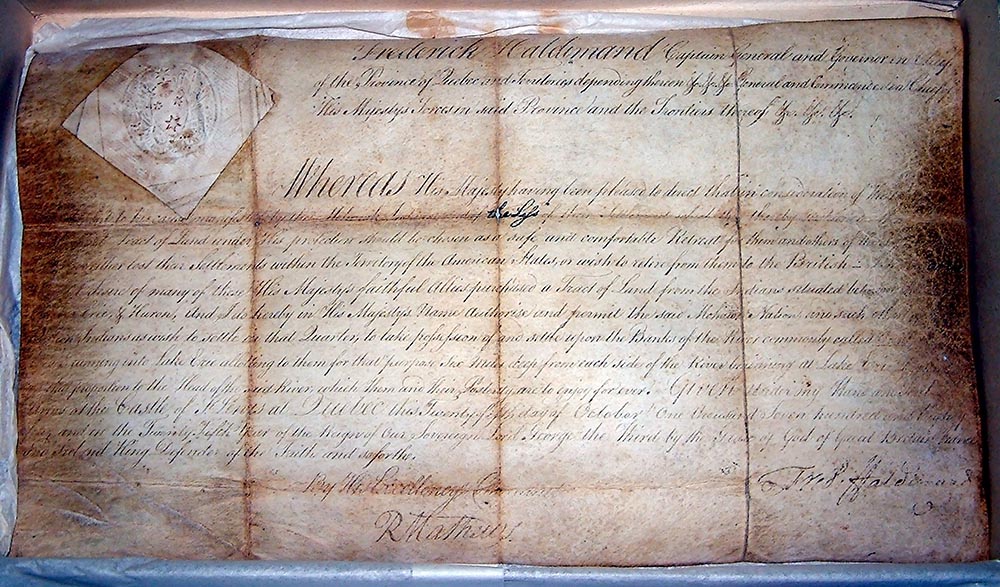
The instrument the Mohawk kept, as it is: the parchment of 25 October 1784, with its seal.
The original parchment, with its seal. It reads “Five Nations” and “Five Nation Indians”, where the registered copy reads “Six”.
How the Tract was narrowed, square by square
The big green square is the Tract the Proclamation gave in 1784, about 950,000 acres. Every smaller square is drawn to the same scale, so its area is its acres. Tap a step, or play them, and watch the grant shrink on paper. The last step brings the outline back, because the acres were taken on paper but the right was never given up.
Each square is drawn to scale: its area is the acres.
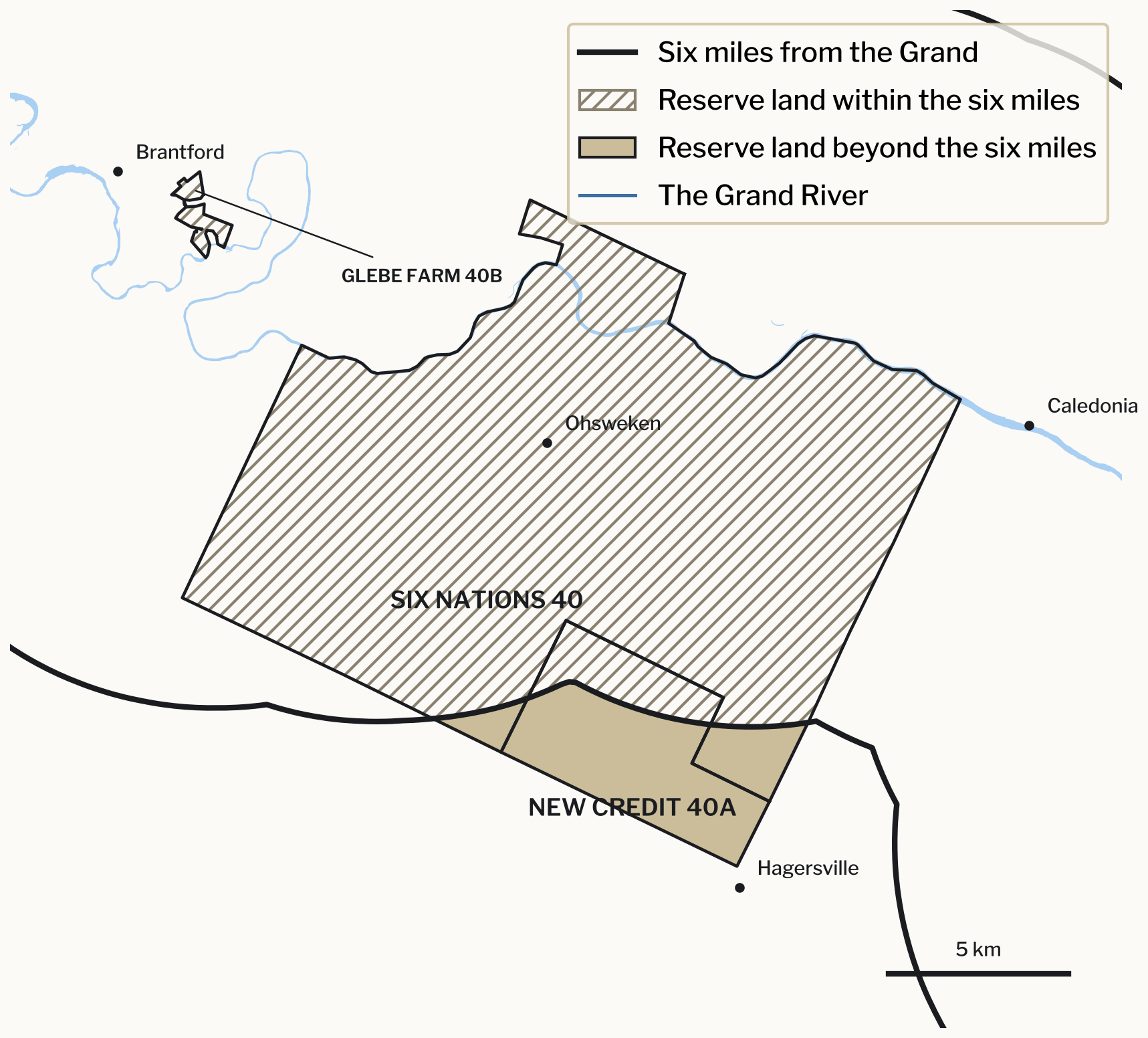
The reserve, on the ground
The same last step, as the map in our letters to the two councils draws it. The black line is the true six miles from the Grand. Hatched land is reserve land inside the six miles: Tract land, given for the Mohawk’s exclusive use. Plain tan is reserve land beyond them, on the Nation’s footing the only part that could be a reserve. For Six Nations 40 that is the two thin strips at the bottom; most of New Credit 40A lies beyond the line, its northern part inside.
Tap the map to open it full size.
Reserve
Area
Inside the six miles
Beyond
Six Nations 40
190 km²
about 184 km²
about 6 km², two strips on the south
Glebe Farm 40B
0.4 km²
all
none
New Credit 40A
25 km²
about 7 km², the north
about 18 km², the south
Reserve limits from the Register’s map files, accurate to about 100 metres; the river from GRCA open data (GRCA Open Data Licence v2). Is your place inside? mohreg.org/is-it-in-the-tract
And the right itself, step by step
Read it from the top. The bar at 1784 is the whole of exclusive use and enjoyment as the Proclamation gave it. Each line below is one instrument that took part of it away, without the class agreeing. The dashed red line is the Patent: refused, but cited as if it had been taken.
1784
The Proclamation To enjoy for ever: the Mohawk and their posterity, exclusive use and enjoyment of the six miles.
1793
The Patent · refused Possession and use only, the Six Nations as one body, no dealing except with the Crown. Refused, but cited ever since.
1839
Crown Lands Protection Act Indian lands in Upper Canada put under a Crown commissioner, as if Crown lands.
1857
Gradual Civilization Act Enfranchisement: a man who qualifies is taken out of the class, and his wife and children with him.
1867
Section 91(24) “Indians, and Lands reserved for the Indians” handed to Parliament, with no word from the class.
1869
Gradual Enfranchisement Act A woman who marries out loses her status, and her children with her: whole branches cut from the list.
1876
The Indian Act A reserve is land “of which the legal title is in the Crown,” set apart for a band. No band existed in 1784.
1924
P.C. 1629 The hereditary council put out by Order in Council; an elected council under the Act put in.
1951
Section 88 Provincial law brought in, so Ontario’s statutes reach the people of the Grand River.
Now
The registry Titles across the Tract registered as if the interest were never there. What is left of exclusive use is the reserve.
The bars show the steps in order, not a measure: each instrument took away part of what 1784 gave, and none was agreed by the class.
How the Patent keeps reaching us
A deed that was refused should have ended in 1793. Instead it has travelled for two centuries, into the places that decide what happens to the land.
On the map
Ontario’s treaty map labels it “Treaty 4, 1793.” Its own list of treaties runs from No. 3 to No. 5, with no No. 4.
In the boundaries
The straight lines on today’s maps follow the survey the Patent confirmed, not the six miles the Proclamation measured from each bank of a winding river.
In the band
The idea that the land is “held for” a band under the Indian Act grows out of the Patent’s collective holding, not out of 1784. The band’s own land case pleads the two deeds together.
In the courts
Isaac v. Davey put the Patent before three courts. The Mohawk were not a party, and the question of whether they ever accepted it was never asked.
In the claims
Collective claims to “use and occupation” travel the Patent’s road, and that road ends with one release signed for everyone.
In the registry
Every title that treats the Patent as its root carries the same defect forward, from one sale to the next.
Who stands on it today
The Patent is not only history. Three things now in force at the Grand River rest on it: the Six Nations land litigation, the standing of the band that brings it, and the authority of the elected council behind both.
One · the claim
The Six Nations litigation
Six Nations v. Canada and Ontario was filed on 7 March 1995, at the direction of the Six Nations of the Grand River Elected Council. Its own summary describes the land as the tract set out in the Haldimand Proclamation and the Simcoe Patent together: “the 1784 Haldimand Proclamation and 1793 Simcoe Patent.”
Canada answers on the same footing, pleading that the Patent “officially confirmed the land grant made to the Six Nations.” Both sides treat the refused deed as the confirmation of the grant.
Six Nations litigation website, summary of position; Canada’s Second Fresh as Amended Statement of Defence, 15 September 2023, para. 1.2
Two · the standing
A band under the Indian Act
The plaintiff is the “Six Nations of the Grand River Band of Indians.” Canada admits it is a band within the meaning of the Indian Act, with standing to sue. The case is brought, and answered, as a band’s claim to a collective holding under the Crown’s protection.
That is the Patent’s road, not the Proclamation’s. The Proclamation was made to the Mohawk and their posterity, and no band existed in 1784.
Canada’s Statement of Defence, para. 2
Three · the council
The elected council and Isaac v. Davey
The elected council was imposed by Order in Council P.C. 1629 in 1924. When the hereditary chiefs challenged it in Isaac v. Davey, the Court of Appeal read the Patent as granting only a personal and usufructuary right, held that the Indian Act applied, and upheld the elected council. The Supreme Court dismissed the further appeal on a separate ground, a Crown trust fund dating from 1835, without construing the Patent.
An earlier case had already drawn the line. In Logan v. Styres (1959), the court held that those who settled under the Haldimand and Simcoe deeds came under the Crown’s protection and became its subjects.
Isaac v. Davey (1975), 5 O.R. (2d) 610 (C.A.); Davey v. Isaac, [1977] 2 S.C.R. 897; Logan v. Styres (1959), 20 D.L.R. (2d) 416 (Ont. H.C.)
The litigation is presented for the elected council by Lonny Bomberry, its Lands and Resources director, and rests on research led by Phil Monture, who directed the Six Nations Land Claims Research Office from 1975 to 2002. Both have spoken publicly for the case as it heads to trial, and Mr. Bomberry has explained its footing in his own words.
The same year, 1995: the council set itself apart from the Mohawk
The council filed its land claim on 7 March 1995. Seven months later, by Band Council Resolution No. 17 of 10 October, it voted $5,000 to support the traditional people in taking a genocide case to the World Court, and two days after that it signed a Memorandum of Agreement with the Mohawk People of the Americas. In that agreement the council describes itself as
Memorandum of Agreement · 12 October 1995
Between the Mohawk People of the Americas, signing by the Turtle, Wolf and Bear, and the Six Nations Council, “an agency enacted through Indian Act section 74 (1) R.S.C. 1985.”
4.1(c) ““Band Councils” means any agency enacted under section 74 (1) Indian Act R.S.C. 1985.”
4.1(d) ““Traditional People” means those persons who practise Heritage-based decision making processes which were in use prior to the arrival of the White People, and which are in use today.”
From the signed Memorandum of Agreement, 12 October 1995.
Seven months earlierThe same council filed the land claim, on 7 March 1995.
Two partiesOne under the Indian Act, one outside it. A council cannot contract with a people it claims to be.
The same resolutionAsked that internal disputes be settled among the people, not in the Canadian courts.
19 August 2026: what the Lands and Resources director told the community
At the council’s community session on the Birkett Lane development, Lonny Bomberry was asked what makes the council certain it holds an interest under the Proclamation. He answered:
“It says the Mohawks and others of the Six Nations. So, uh, it was going towards that point where, uh, we’re all grouped as, uh, one body together.” “So that’s how we determined that it’s not exclusively the Mohawks.”
“…confirmed that they are the lawful government in the case of Isaac and Davies by the Supreme Court of Canada in nineteen seventy-seven.”
“There isn’t actually any treaty that was made with the chiefs at the time. It was simply a proclamation on an understanding.”
Session of 19 August 2026, as transcribed in letter SG0311-260820-T00001.
20 August 2026: what was asked of the council in writing
The next day the Mohawk Nation of Grand River wrote to the band as plaintiff, to Mr. Bomberry as the officer who answered, and to counsel of record, with the Attorneys General of Canada and Ontario copied as parties to the action. It set the session’s answers beside the council’s own 1995 instrument and asked the council to produce two things: a delegation from the Mohawk people authorising it to represent or settle the Haldimand posterity interest, and a surrender of any part of the Tract executed by the Mohawk of the Grand River. It undertook to withdraw its objection in writing if either exists.
The answer to the first question is already in the director’s own words: the council’s claim to speak for the Mohawk rests on reading two named classes as “one body,” and its authority rests on Isaac v. Davey, the case built on the Patent Brant refused.
Put together: the claim pleads the Patent as confirming the grant, the plaintiff stands as an Indian Act band, and the council that directs it draws its authority from an order the courts upheld by reading the Patent. Every layer runs back to the deed Brant refused. None of it was made with the Mohawk of the Grand River, who stand on the Proclamation instead.
The line of the Crown’s word
The same line the Pledge and the Proclamation sites draw, from 1779 to now. The Patent is marked: the one step the Grand River Mohawk refused.
Governor Haldimand ratifies a promise to some of the Mohawks of Canajoharie, Tikondarago and Aughquaga, who lost their settlements for their attachment to the King: when the war ends they will be restored, at the Crown’s expense, to the state they were in before it.
On 25 October, in the King’s name, the lands six miles deep from each side of the Grand River, from Lake Erie to its head, are set apart for the Mohawk and their posterity, to enjoy for ever. The Pledge is kept.
1789
The Mark of Honour
Lord Dorchester’s Order in Council of 9 November marks those who adhered to the Crown before 1783, and all their descendants by either sex, with the letters U.E.
1791
Faith pledged again
The Crown confirms the Proclamation. At the Land Board a straight survey is agreed, a centre line with limits six miles either side, though the Grand does not run straight; a further instrument is promised to settle the lands.
1793
The Patent refused
Simcoe’s Patent of 14 January is offered as that instrument. The Grand River Mohawk never accept it.
1796
Ascertained on oath
Simcoe’s Proclamation of 6 April names the magistrates to receive and record, on oath, who are of the Loyalists. For the Mohawk of the three villages it is never carried out.
1867
Section 109
Ontario takes the Crown’s lands subject to “any Interest other than that of the Province in the same.” The Mohawk interest is that other interest.
1982
Section 52
The Constitution is the supreme law, and any law inconsistent with it is of no force or effect.
Bills to settle it for Parliament and for Ontario are drafted, and every member along the river is written to.
The record of refusal
The refusal is not a later story. It is in the Crown’s own papers and in the history books, from the year the Patent was offered.
22 May 1784
The Mississaugas surrender
The Mississaugas surrender the lands between the lakes to the Crown: the purchase out of which the Grand River lands were given.
25 Oct 1784
The deed of gift
In the King’s name, Haldimand gives the lands six miles deep from each side of the Grand River to the Mohawk and their posterity, “to enjoy for ever.”
March 1791
Brant petitions Lord Dorchester
He presses for the strongest title the Crown can give, and warns that a restricted grant would be “not much better than a Yankee deed.” As it is told on the Grand River, the answer was that the King had nothing higher to give.
24 Dec 1791
The faith of Government is pledged
The Executive Council’s committee for the District of Nassau weighs the Grand River and Bay of Quinte tracts together and records that “the faith of Government is pledged to the Mohawk Chiefs for the two tracts.” It proposes two ways to secure them: an Act of the Provincial Legislature, or a grant under the great seal.
Library and Archives Canada, RG 10, vol. 8, p. 8209
14 Jan 1793
The grant is made, and rejected
The Patent confirms the boundaries Jones surveyed, stops the Tract at the Falls near Elora, about 675,000 acres, and names the Six Nations. Brant and the Grand River chiefs reject it and declare that it is not binding on them.
The Canadian Encyclopedia, “The Haldimand Grant, 1784”
1793
Possession and use, not ownership
The deed Simcoe offers Brant allows only possession and use of the lands, not ownership. Brant turns it down.
John S. Hagopian, “Joseph Brant vs. Peter Russell,” Histoire sociale / Social History (1997)
1 Apr 1793
The two tracts part ways
The Bay of Quinte Mohawk take up Simcoe’s deed, Treaty 3½, and the Crown’s protection with it; they are governed under it today as an Indian Act band. The Grand River Mohawk keep the grant as it was made.
1795
Simcoe records the refusal
Writing to Dorchester, Simcoe himself reports that Brant and the Grand River Mohawk refused the proposed grant. The refusal is recorded by the very officer who offered it.
Simcoe Correspondence (Cruikshank), vol. 4: page being confirmed
1803
“For the exclusive benefit of the Mohawk nation”
Recording the events of that year, William L. Stone writes that the Grand River grant had been “notoriously made for the exclusive benefit of the Mohawk nation.”
Life of Joseph Brant, 1838, vol. II, p. 415
6 Mar 1922
Asked at Westminster
In the British House of Commons, Lord Cavendish-Bentinck asks when the treaty was denounced. Winston Churchill cannot say, and passes the question to Canada. It has not been answered since.
12 Oct 1995
The council sets itself apart
Seven months after filing its land claim, the elected council signs a Memorandum of Agreement with the Mohawk People of the Americas, describing itself as an agency under section 74 of the Indian Act and the Mohawk People as a separate party.
Today
The other path
The second path the 1791 committee proposed, an Act of the Legislature, was never taken. The Haldimand bills are that Act.
Read the Patent, line by line
The whole Patent, as Simcoe put it under the great seal. Words in red are where it departs from the Proclamation of 1784: who takes, how far, what kind of holding, and the bar on dealing with anyone but the Crown. Words in green-grey are where it repeats the Proclamation. The notes in the margin set the two side by side.
Simcoe’s Patent of the Grand River Lands · 14 January 1793
George the Third, by the Grace of God of Great Britain, France and Ireland, King, Defender of the Faith and so forth. To all to whom these presents shall come Greeting —
Know ye that whereas the attachment and fidelity of the Chiefs, Warriors and people of the Six Nations to Us and our Government has been made manifest on divers occasions by their spirited and zealous exertions and by the bravery of their conduct and We being desirous of showing our approbation of the same and in recompense of the losses they may have sustained of providing a convenient Tract of Land under our protection for a safe and comfortable Retreat for them and their posterity
Have of our special Grace certain Knowledge and mere motion given and granted and by these presents Do Give and Grant to the Chiefs, Warriors, Women and people of the said Six Nations and their heirs for ever All that District or Territory of Land being parcel of a certain District lately purchased by us of the Mississague Nation lying and being in the Home District of Our Province of Upper Canada, beginning at the mouth of a certain River formerly known by the name of Ours or Grand River now called the River Ouse, where it empties itself into Lake Erie and running along the Banks of the same for the space of six miles on each side of the said Riveror a space co-extensive therewith conformably to a certain survey made of the said Tract of Land and annexed to these presents and continuing along the said River to a place called or known by the name of the forks and from thence along the main stream of the said River for the space of six miles on each side of the said stream or for a space equally extensive therewith as shall be set out by a survey to be made of the same to the utmost extent of the said River as far as the same has been purchased by Us and as the same is bounded and limited in a certain Deed made to us by the Chiefs and people of the said Mississague Nation, bearing date the seventh day of December in the year of our Lord one thousand seven hundred and ninety-two
to Have and to Hold the said District or Territory of Land so bounded as aforesaid of Us our Heirs and successors to them the Chiefs Warriors Women and people of the Six Nations and to and for the sole use and behoof of them and their heirs for ever freely and clearly of and from all and all manner of Rents, fines and services whatever to be rendered by them or any of them to Us or Our Successors for the same and of and from all conditions stipulations and agreements whatever except as hereinafter by Us expressed and declared
Giving and Granting and by these presents confirming to the said Chiefs Warriors Women and people of the Six Nations and their heirs the full and entire possession Use benefit and advantage of the said District or Territory to be held and enjoyed by them in the most free and ample manner and according to the several customs and usages of them the said Chiefs Warriors Women and people of the said Six Nations
IT IS OUR ROYAL WILL AND PLEASURE that no transfer alienation conveyance sale gift exchange lease property or possession shall at any time be made or given of the said District or Territory or any part or parcel thereof by any of the said Chiefs Warriors Women or people person or persons whatever other than among themselves the said Chiefs Warriors Women and people, but that any such transfer alienation conveyance sale gift exchange lease or possession shall be null and void and of no effect whatever.
And that no person or persons shall possess or occupy the said District or Territory or any part or parcel thereof by or under pretence of any such alienation Title or conveyance as aforesaid or by or under any pretence whatever under pain of our severe displeasure And that in case any person or persons other than them the said Chiefs Warriors Women and people of the said Six Nations shall under pretence of any such title as aforesaid presume to possess or occupy the said District or Territory or any part or parcel thereof that it shall and may be lawful for us our Heirs and Successors at any time hereafter to enter upon the Lands so occupied and possessed by any person or persons other than the people of the said Six Nations and them the said intruders thereof and therefrom wholly to dispossess and evict and to resume the part or parcel so occupied to Ourselves, our heirs and successors
Provided always that if at any time the said Chiefs Warriors Women and people of the said Six Nations should be inclined to dispose of and surrender their use and interest in the said District or Territory or any part thereof the same shall be purchased for Us, our Heirs and Successors at some public meeting or assembly of the Chiefs Warriors and people of the said Six Nations to be holden for that purpose by the Governor, Lieutenant-Governor or person administering Our Government in our Province of Upper Canada
IN TESTIMONY whereof, We have caused these our Letters to be made patent and the great seal of our said Province to be hereunto affixed. Witness, John Graves Simcoe, Esquire, Lieutenant-Governor and Colonel commanding our forces in Our said Province. Given at Our Government House at Navy Hall this fourteenth day of January in the year of our Lord, One thousand seven hundred and ninety-three, in the thirty-third year of Our Reign.
SimcoeJarvisNo Mohawk signature
Text as received by the Secretariat on 18 November 2026, set without change except one doubled word (“by by”). To be checked against Indian Treaties and Surrenders (Ottawa, 1891), vol. I, and Johnston, The Valley of the Six Nations (1964).
Who takesThe Proclamation: the Mohawk Nation, and such others of the Six Nations as wish to settle. Here: “the Chiefs, Warriors, Women and people of the said Six Nations and their heirs,” one body.
How farThe Proclamation: six miles from each side, from the lake to the head of the river. Here: “a space co-extensive therewith conformably to a certain survey,” and only “as far as the same has been purchased by Us” under the Mississauga deed of 7 December 1792.
What kindThe Proclamation: “which them and their posterity are to enjoy for ever.” Here: “possession Use benefit and advantage,” “under our protection.”
No dealingThe Proclamation sets no such bar. Here: no sale, lease or gift except “among themselves,” intruders evicted and the land resumed by the Crown, and any surrender only to the Crown, at a public meeting called by the Governor.
KeptThe recompense for the losses they sustained; their posterity; the six miles from the mouth at Lake Erie; and enjoyment “according to the several customs and usages” of the people.
Indian Treaties and Surrenders, 1891
Indian Treaties and Surrendersfrom 1680 to 1890
Vol. I
Ottawa, 1891 Printer to the Queen
Research in progress
The Crown’s own printed collection of treaties and surrenders. The question for this panel: does it print the Grand River Patent, under what number, and does it record any acceptance? If it skips the Patent, or prints it unnumbered, the Crown’s own record does not treat it as a treaty.
When the search is done, this panel will show the page itself, with the answer in one line above it.
Are you inside the true six miles?
The Nation’s Tract lookup measures six miles from each bank of the Grand River, mouth to source, and shows whether an address falls inside it, and whether it falls inside the straight survey of 1791.
The Deed That Was Refused: the six miles against the straight survey, the missing No. 4, nothing left to convey, the chain. A3, full quality for print.
Cite this page. Mohawk Nation of Grand River Secretariat, “The Simcoe Patent, 14 January 1793: the deed that was refused,” simcoepatent.org (18 November 2026).
The bills
Where the five bills stand, read from the bills page, and what they do in three plain lines. They take no home, no farm and no reserve lot from anyone.
Wasn’t the land still the King’s to grant in 1793?
Not on the Grand River. The Mississaugas surrendered the lands to the Crown in May 1784, and in October the King gave them on, by deed of gift, to the Mohawk and their posterity for ever. A gift keeps nothing back, and when Brant asked for something better, the answer, as it is told on the Grand River, was that there was nothing higher to give. A patent can pass only what the Crown still holds; in 1793 it held nothing there to pass. The Crown will point to Simcoe’s minute that the property stayed with the King, which is the Patent’s reading of 1784, and the reading Brant refused.
Isn’t the Patent “Treaty 4”?
Ontario’s treaty map calls it that, yet the Province’s own list of treaties skips from No. 3 to No. 5. The deed Simcoe made that year which was accepted, at the Bay of Quinte, is known as Treaty 3½. A deed refused by the people it was offered to is no treaty with them, whatever number is written on a map.
Doesn’t the Six Nations case rely on the Haldimand Proclamation too?
It does. It pleads the Proclamation and the Patent together, and argues the Proclamation was a treaty. But it treats the Patent as the confirmation of the grant, it is brought by a band under the Indian Act, and the council that directs it rests on Isaac v. Davey. The question is not whether the Proclamation is mentioned, but which instrument the claim, the standing and the council actually stand on.
If it was refused, why have courts read it?
Because it was put in front of them. Isaac v. Davey was a dispute between the elected council and supporters of the hereditary chiefs over the council house at Ohsweken. The Mohawk were not a party, and no court was asked whether they had ever accepted the Patent. A court reading a document is not the same as a people agreeing to it.
Why give a refused deed a page of its own?
Because it is the one people are handed. Anyone who looks up the Patent, whether a lawyer, a reporter, a student or a clerk in a land office, should find the whole account in one place: what it offered, why it failed, and that it was refused.
Doesn’t this put neighbours’ homes at risk?
No. The quarrel is with the Crown, which made a promise and then let its provinces and registrars act as if a refused deed had been accepted. The families living along the river were never told. Setting the record straight serves them as much as it serves the Mohawk.
What would put this right?
The 1791 committee named two ways to secure the Mohawk in their lands. The grant under the great seal was refused. The Act of the Legislature was never passed. The Haldimand bills, at haldimandbills.org, are that Act.
The Patent is the deed everyone uses. The Proclamation is the deed the Mohawk kept.
Minute of the Committee of the Executive Council, District of Nassau, 24 December 1791. Library and Archives Canada, RG 10, vol. 8, p. 8209.
The Canadian Encyclopedia, “The Haldimand Grant, 1784.”
John S. Hagopian, “Joseph Brant vs. Peter Russell: A Re-examination of the Six Nations’ Land Transactions in the Grand River Valley,” Histoire sociale / Social History (November 1997), citing Charles M. Johnston, The Valley of the Six Nations (Champlain Society, 1964).
William L. Stone, Life of Joseph Brant — Thayendanegea (1838), vol. II, p. 415.
The Canadian Encyclopedia, “Crown Grant to the Mohawks of the Bay of Quinte (Treaty 3½).”
Isaac v. Davey, [1973] 3 O.R. 677 (H.C.); (1975), 5 O.R. (2d) 610 (C.A.); Davey v. Isaac, [1977] 2 S.C.R. 897.
Six Nations of the Grand River litigation website (sngrlitigation.com), summary of the plaintiff’s position.
Second Fresh as Amended Statement of Defence of Canada, 15 September 2023, paras. 1.2 and 2.
Six Nations Lands and Resources, “Six Nations v. Canada and Ontario: Litigation” (sixnations.ca).
Logan v. Styres (1959), 20 D.L.R. (2d) 416 (Ont. H.C.).
“Who Rules the Valley of the Six Nations? (A Discussion of Isaac v. Davey),” McGill Law Journal, vol. 22, no. 1.
Turtle Island News, “Six Nations Elected Council heading to courts over massive land rights case,” 29 October 2025.
University of Waterloo School of Architecture, “Phil Monture” (biography).
Six Nations Council, Band Council Resolution No. 17, 10 October 1995, and Memorandum of Agreement with the Mohawk People of the Americas, 12 October 1995.
Six Nations Lands and Resources community engagement session on the Birkett Lane development, 19 August 2026 (recording and transcript).
Mohawk Nation of Grand River, letter SG0311-260820-T00001 to the Six Nations of the Grand River Band of Indians and counsel of record, 20 August 2026.
United Kingdom, House of Commons Debates, 6 March 1922.
Joan Holmes, report of 19 January 2009 and supplemental report of 2 February 2009, prepared for the City of Brantford.
Government of Ontario, Map of Ontario treaties and reserves; list of treaties and surrenders.
What’s newá:se’
simcoepatent.org joins the set: the Simcoe Patent of 14 January 1793, the deed the Grand River Mohawk refused, and who still stands on it. See them
The letters are posted, with the bills enclosed: to every member of Parliament and of the Legislature whose riding lies on the Tract, to all eight candidates in the Brantford–Brant South byelection, to the two councils whose reserves lie on it, and to the Senate: the Speaker, the Government Representative, the leader of each group and every senator for Ontario. See them
The Two Row Times editorial “Suppose It Were Read” asks what a Haldimand bill would reveal if it were read. See them
haldimandproclamation.org, haldimandpledge.org and haldimandbills.org open.